Guide › The cards › EXIT card
📤 The EXIT card
Every other card is about entries. This one closes the loop: your
position was just sold, and here's the report — not a display report, an
on-chain-verified one: the SOL that actually came back to your wallet, fees and
slippage included.
When does it arrive?
In your personal Telegram feed, when one of your positions closes (or partially sells): a
sale triggered by a stop-loss, a take-profit, a copy-sell (the wallet you copy sold), or a
manual sale. Green background for a winning trade, red for a
losing one — the app never dresses up a loss.
Why “on-chain verified” isn't a slogan
The displayed PnL isn't computed from a theoretical price: it comes from the sell transaction
itself — the SOL received, observed on the blockchain, compared to the SOL invested. If a sale
fails on-chain, no success card goes out. What the card says, your wallet confirms.
The anatomy of the card
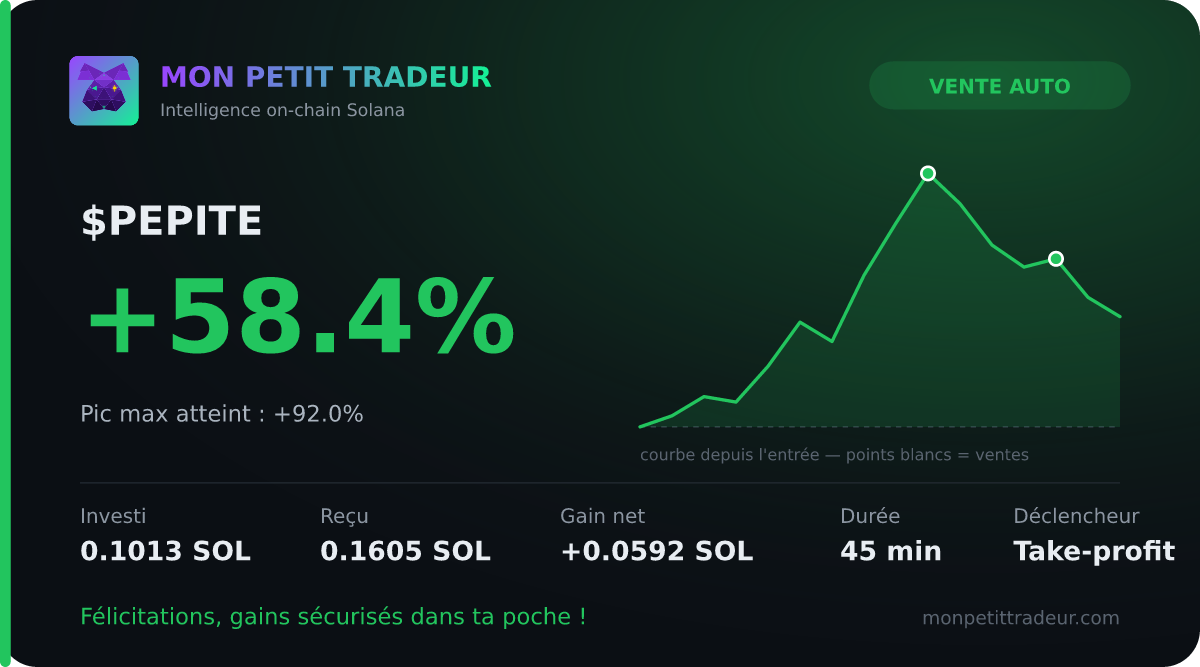
Card generated by the app's real rendering engine
(fictional token $PEPITE). Cards are delivered in French — every zone is explained below.
 1
2
3
4
5
6
7
8
1
2
3
4
5
6
7
8
- The trigger badge
WHO sold:
VENTE AUTO (auto-execution), Stop-loss,
Take-profit, Copy-sell or Manuel (you). Knowing what
triggered each exit is where improvement starts.
- The token
The closed position's ticker.
- The real PnL
THE number on the card: the result in percent, net —
computed on the SOL actually received, not on a displayed price. Green = gain, red =
loss.
- The max peak reached
The highest point the position touched during its life. The gap between the
peak and your exit (+92% → +58.4% here) is the “give-back”: the share of the top your exit
strategy didn't capture. It's THE metric Mastermind works on permanently.
- The life curve
The position's full journey since entry. The white dots are
your sells: a tranche exit shows several. The dashed line is 0% — everything above it was
profit.
- The curve caption
The reading reminder: “curve since entry — white dots = sells”.
- The 5-figure row
Invested · Received · Net gain · Duration · Trigger — the complete
accounting, detailed in the glossary below.
- The closing message
Green: “gains secured in your pocket”. Red: a sober statement, never fake
consolation. Emojis live in the Telegram message that accompanies the card.
The card's glossary
- Invested (Investi)
- The SOL that left your wallet to open the position — buy fees included. The real cost, not
the nominal amount.
- Received (Reçu)
- The SOL that came back to your wallet on the sale, after slippage and fees. On a tranche
exit, it's the cumulative total of all sells.
- Net gain (Gain net)
- Received minus invested. The only number that pays: positive, it's in your pocket;
negative, it's gone. Everything else is commentary.
- Duration (Durée)
- Time between opening and closing. In memecoins, good exits often play out in tens of
minutes — our measurements put the typical peak zone around 20 minutes after the signal.
- Trigger (Déclencheur)
- The mechanism that launched the sale. Stop-loss: price hit your
protection level (a stop-loss triggered in profit = the trailing stop locking in a gain).
Take-profit: your gain target. Copy-sell: the wallet you
copy sold, you followed. Manual: you, in the app.
What to do when it arrives
- Check the trigger: is it the scenario you planned at entry? If your
positions always close differently than planned, your strategy and your settings aren't
talking to each other.
- Look at the give-back (peak − exit): if it's systematically huge, your
exits are too late or too greedy.
- File it mentally and move on: a red card doesn't call for revenge. The
worst trade is the one made to “win it back”.
What this card is not
A report, not a grade: a winning trade can have been played badly (exiting at +58% on a token
that went +400%) and a losing one played well (a clean stop-loss at −20% before a −90%). Judge
the decision, not just the outcome.
 MON PETIT TRADEUR · GUIDE