Guide › The cards › BUY SIGNAL card
🧠 The BUY SIGNAL card
This is the most important card in the app: it fires when several
“smart money” wallets buy the same token within a short window. Everything Mastermind
knows at signal time fits on it. Here's how to read it, zone by zone.
When does it arrive?
Mastermind continuously watches wallets selected for their measured track record (earliness,
consistency, volume). When several of them converge on the same token, the
signal first goes through an automatic safety screen — minimum liquidity,
holder concentration, sellability (anti-honeypot), token authorities revoked. Whatever fails
that screen is never broadcast. Whatever passes gets a score, an analysis, and the card
reaches you:
- in the app, Trading tab (live feed);
- on Telegram: as private messages depending on your settings — Premium
members receive the selective signals, the free plan receives 2 buy signals per day.
Before anything else
A signal is
not a buy order. It's information: “wallets that win often just
bought this — here's what we know.” The decision — and the risk — remain yours.
The anatomy of the card
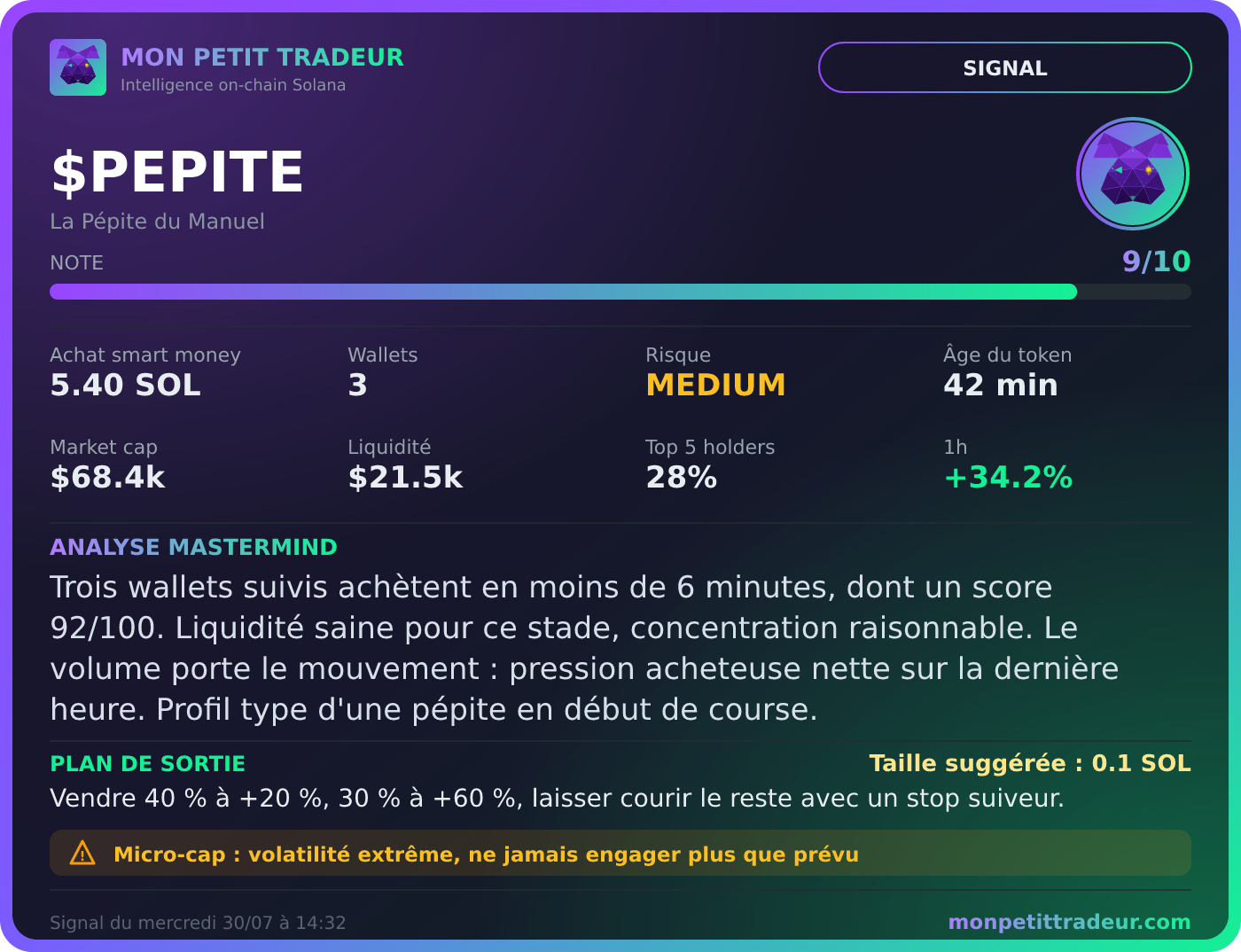
The card below is generated by the app's real
rendering engine, with a fictional token ($PEPITE). Cards are delivered in French — each zone is
explained in English below.
 1
2
3
4
5
6
7
8
9
10
1
2
3
4
5
6
7
8
9
10
- The source badge
Where the signal comes from.
SIGNAL = smart-money confluence
(several wallets). You'll also see SOLO ELITE (a single exceptional wallet) or
SPIKE (sudden acceleration) — each has its own card, covered in this guide.
- The token
Its ticker (
$PEPITE) and full name. The token's exact address
(the “mint”) is always attached to the message — that's the source of truth: dozens of
tokens share a ticker, only one has that address.
- The token logo
Fetched on-chain. If missing, the card shows initials — that says nothing
about the token's quality.
- The 0–10 SCORE (“NOTE”)
Mastermind's conviction. Every broadcast signal starts at 10
and loses points for each observed flaw (thin liquidity, average wallets, high
concentration…). A high score = few detected flaws — not a promise of profit. The score
never blocks broadcasting: it helps you compare signals against each other.
- The 8-statistic grid
The token's state at signal time — each stat covered in the glossary below.
These are values at emission: on a memecoin, they move fast. (Labels on the card:
“Achat smart money” = smart-money buy-in, “Âge du token” = token age, “Liquidité” =
liquidity.)
- The MASTERMIND ANALYSIS
Four lines max: why this signal exists, what's reassuring, what's worrying.
It's the “why” behind the score.
- The EXIT PLAN (“PLAN DE SORTIE”)
The suggested selling strategy, calibrated on the measured anatomy of our
peaks (typical duration, magnitude). Selling in tranches locks in gains without giving up
the rest of the move. It's a suggestion — not a guarantee the token will rise.
- The suggested size (“Taille suggérée”)
The bet size consistent with the signal's risk AND the current market mood.
When the global market is bearish, it shrinks. Don't raise it because a signal “looks
safe” — none is.
- The warning banner
Present only when a vigilance point deserves big print — here, micro-cap
volatility. If this banner exists, read it first.
- The card footer
Date and time of emission. A signal older than 20 minutes is already old at
memecoin scale — check the current price before acting.
The card's glossary
- Smart-money buy-in (Achat smart money)
- Total SOL committed by tracked wallets on this token at signal time. The higher it is, the
more these wallets are putting their money where their mouth is. 5.40 SOL on a micro-cap is
real commitment — not a 0.05 test.
- Wallets
- How many tracked wallets bought. 3 independent wallets within minutes are worth
more than one big buy: convergence is what makes the signal.
- Risk (Risque)
- Mastermind's verdict on the token itself: LOW =
clean profile, MEDIUM = the usual flaw of young tokens,
HIGH = a real structural red flag (extreme concentration,
fragile liquidity…). Independent from the score: a 9/10 can carry high risk — excellent
wallets, dangerous token.
- Token age (Âge du token)
- Time since the trading pair was created. Young = more upside AND more danger. Our
measurements show earliness is the #1 factor behind big peaks — that's exactly why we hunt
early, knowingly.
- Market cap
- The token's total theoretical value (price × supply), in dollars. A $68k micro-cap can do
×10… or go to zero. Mostly useful to size up the order of magnitude of the bet.
- Liquidity (Liquidité)
- The money actually available in the trading pool. This is safety stat #1:
it decides whether you'll be able to sell back without crushing the price. $21k of
liquidity absorbs a 0.1 SOL exit easily — not a 5 SOL one.
- Top 5 holders
- The share of the token held by the 5 biggest wallets. Above 40%, caution; above 60%, five
people can crush the price by selling. 28% as shown = reasonable distribution for a young
token.
- 1h
- Price change over the last hour. Green = the move is already carrying; red = you'd be
buying a falling knife. Cross-check with age: +34% on a 42-minute-old token is normal; on a
3-day-old token it's a wake-up.
What to do when it arrives
- Read the warning banner if there is one, then risk and liquidity.
- Check freshness (footer) and the current price — not the signal's.
- Decide your size: never more than the suggested size, never money you
need.
- Set your exit BEFORE entering: that's what the card's exit plan is for.
The profit is made on the sell, not the buy.
- If you pass: perfectly fine too. There will always be a next signal —
fear of missing out is the worst reason to enter.
What this card is not
Neither investment advice nor a prediction. Mastermind measures and informs; it guarantees
nothing. Memecoins can lose 100% of their value in minutes. Only commit what you can afford to
lose entirely.
 MON PETIT TRADEUR · GUIDE