Guide › The cards › SOLO ELITE card
👑 The SOLO ELITE card
Its cousin, the SIGNAL card,
requires several wallets to converge. Here, a single wallet buys — but not just
any wallet: one whose measured track record puts it in our radar's elite. The card
dresses in gold, and it reads differently.
When does it arrive?
Mastermind continuously grades the wallets it watches: earliness, consistency, win rate,
volume. When a wallet from the top of the ranking enters a token alone —
without waiting for the others — and the signal passes the safety screen, the card goes out to
Premium members on Telegram and into the app. The public only sees a masked
teaser at the end of the day (the “solo elite of the day” card).
The fundamental difference vs. the SIGNAL card
A 3-wallet confluence confirms itself. Here,
nobody confirms anybody: the
entire conviction rests on one actor's pedigree. It's written in plain words at the card's
footer: “individual signal, no confirmation” (
signal individuel, sans confirmation).
Smaller size, faster exit.
The anatomy of the card
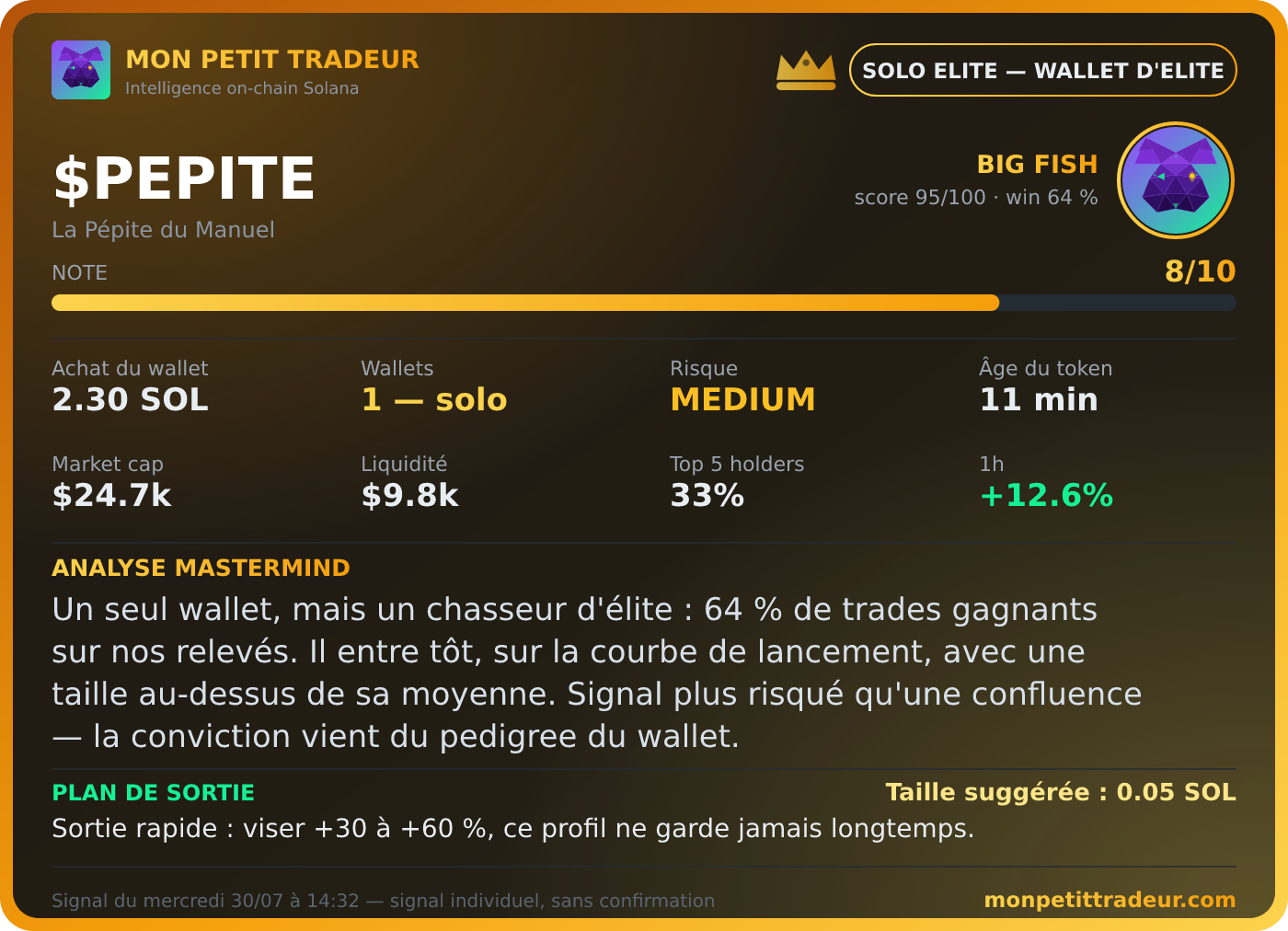
Card generated by the app's real rendering engine
(fictional token $PEPITE). Cards are delivered in French — every zone is explained below.
 1
2
3
4
5
6
7
8
9
10
1
2
3
4
5
6
7
8
9
10
- The golden badge
SOLO ELITE — WALLET D'ELITE with the crown. The gold theme of
the whole card means one thing: the source is a single wallet, not a confluence.
- The token
Ticker and full name — as on every card, only the mint address attached to
the message is the source of truth.
- The wallet's ID card
Its label (
BIG FISH), its score out of 100
(measured quality: earliness, consistency, volume) and its win rate on our
records. Read this block FIRST: it's what replaces the confirmation of other wallets.
- The token logo
Fetched on-chain, initials as fallback.
- The 0–10 SCORE
Same scale as the SIGNAL card (starts at 10, loses points per observed flaw) —
but a solo starts with a natural handicap: the absence of confluence is itself a caution
point.
- The 8-statistic grid
Identical to the SIGNAL card (see its
detailed glossary), with one difference: “Achat du wallet” (wallet's buy-in) replaces the
smart-money total, and the Wallets cell shows
1 — solo in amber so the
single-actor nature jumps out.
- The MASTERMIND ANALYSIS
On a solo, it mostly talks about the wallet: its entry style, its
usual size, what its history says about this specific trade.
- The EXIT PLAN
Often more aggressive than on a confluence: elite solo wallets rarely hold
long — the plan aligns with their style.
- The suggested size
Generally smaller than an equivalent SIGNAL card. One scout = a more
concentrated bet.
- The card footer
“Individual signal, no confirmation” — the permanent reminder of this
signal's nature, next to the timestamp.
The card's glossary
- Score /100
- The wallet's quality grade, computed on its observed history: does it arrive early
(earliness), win consistently, hold its positions, and how much does it commit? A score ≥ 90
puts a wallet in the very top basket of our radar.
- Win rate
- The share of its complete round-trips that ended in profit, on what we've
observed — not its lifetime history. 64% in memecoins is an excellent figure: most
traders there lose.
- “1 — solo”
- The visual reminder that no other tracked wallet has bought (yet). If others enter later, a
classic confluence signal may follow — that's actually a good sign.
What to do when it arrives
- Look at the score and win rate first — they're the signal's entire
thesis.
- Reduce your size vs. what you'd do on a confluence. The suggested size
already does it for you.
- Prepare a fast exit: these profiles take profits quickly, and when the
scout leaves, the party is usually over.
- Very young token + a single buyer = maximum volatility. If you're not
comfortable, this signal isn't for you — and that's a perfectly valid decision.
What this card is not
A 95/100 wallet is still a trader who loses 36% of the time. Neither investment advice nor a
prediction: a brilliant history protects no individual trade. Only commit what you can afford
to lose entirely.
 MON PETIT TRADEUR · GUIDE